
I see DesireX as a name that can turn a founder’s taste into a clear public proposition. In this concept, I am outlining the choices that would make the idea credible, useful, and distinct.
A house people can sense
You may already have a formula, a perfumer relationship, or a private practice mixing fragrance for rooms and people. I see DesireX giving that work a larger frame without forcing it into a conventional perfume label. The name begins with attraction and leaves the source open. That space is valuable for scent, where memory, place, skin, and imagination meet before language catches up.
The house could begin with personal fragrance, incense, candles, or a single room composition. Houses such as Le Labo and Editions de Parfums Frédéric Malle show how a distinct point of view can hold a range. It could also begin with the objects around scent: a vessel, a burner, a cabinet, or a travel case. DesireX holds all of those expressions because it names the impulse behind them. Your current work stays intact. The new address lets customers see each product as part of one sensory point of view.
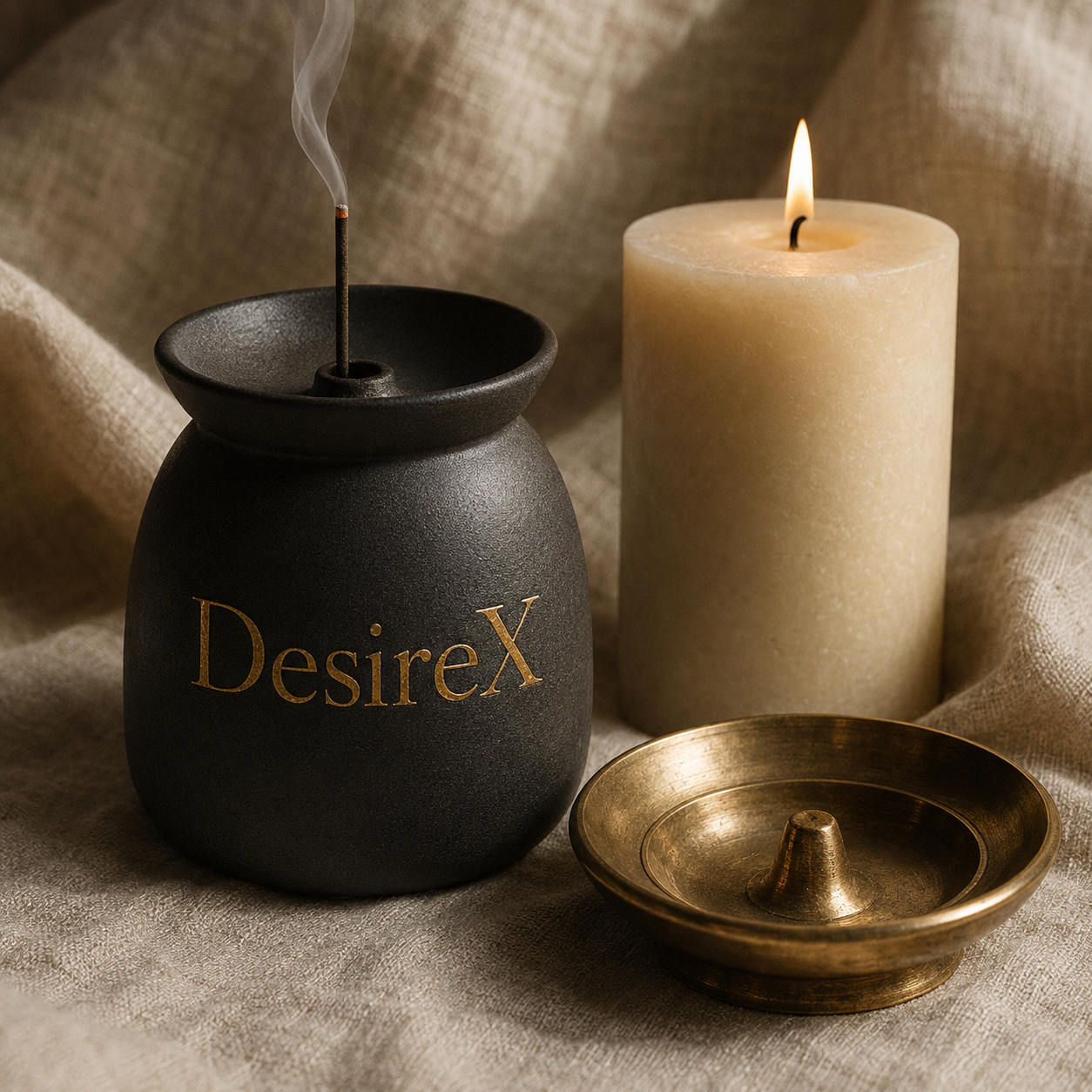
Choose one atmosphere first
A convincing debut can be narrow. One atmosphere interpreted across a fragrance, an incense, and a refillable object gives customers several ways to enter. The idea might come from a room you know, a material you handle, or a memory that has resisted every previous formula. Specificity creates character. The launch should feel like an invitation into your world, not a shelf filled to meet every preference.
Sampling can make the invitation generous. A small set lets someone live with the composition at different hours before choosing a full bottle or vessel. Clear notes about use, materials, and care support that intimacy. DesireX should communicate with confidence while leaving the wearer room for a private response. A scent becomes meaningful in someone else’s life, and the brand gains strength when it respects that transfer.
Design beyond the bottle
The name wants a complete physical language. Glass weight, cap movement, label texture, and the sound of a box opening all shape the first encounter. Those details need not be ornate. Restraint can make a composition feel more present. DesireX can appear as a small signature, giving the material and scent space while remaining unmistakable on a dressing table or shelf.
If you already make beautiful fragrance under another name, the domain could support a special line or a more experimental house. It can create permission for collaborations that do not fit the original range. A ceramicist might design a burner around diffusion. A textile studio might explore how scent stays in fiber. Each project expands the world while the central name keeps it coherent.
Turn process into intimacy
Customers are curious about how a scent reaches its final balance. You can show trials, materials, and decisions without pretending to reveal a formula. A perfumer speaking about one stubborn note can be more compelling than a long list of adjectives. The education offered by The Perfume Society and the community knowledge gathered by Fragrantica show how informed context can invite people further into the craft. A study of how incense moves through a room can help someone understand use. These glimpses make the house human and give buyers reasons to follow its development.
The same care belongs in the practical experience. Sampling, delivery, refills, and replacements should feel considered. Instructions can be direct and attractive. Questions deserve informed answers. When the object empties, a refill can return it to use instead of sending it away. DesireX can make repeat purchase feel like continuation, preserving both the customer relationship and the physical presence of the house.
Give the scent a place
Fragrance becomes clear in a room. A temporary installation can let visitors smell raw materials, try the finished work, and notice how it changes with distance. The setting might be a studio for one evening or a quiet room for a week. It needs patience more than spectacle. Appointments, open hours, and small conversations allow the composition to unfold on its own terms.
A physical presentation also reveals what photographs cannot. You learn where people pause, which words they reach for, and which format feels natural in the hand. That response can inform the next release without making the first one feel like a test. DesireX.com remains the lasting entrance after the room closes, carrying samples, refills, notes, and future invitations to people who want to return.
Claim the association
DesireX sounds at home on fragrance because desire is already part of the medium. The X adds tension. It can be an ingredient, a person, a place, or the unknown reaction between a composition and its wearer. The name is expansive enough for body, home, and designed objects, yet distinctive enough to give the house a sharp outline. That balance is difficult to manufacture later.
If you have been waiting for a name that can carry the full ambition, the open window will not remain yours indefinitely. Another founder can attach DesireX to another scent, another object, and another visual language. Once that connection settles, it becomes harder to recover. Buying the domain secures a clean beginning. A partnership is possible for a founder with a strong plan. The next move is to share what you want the house to feel like.

Michael Santiago
Michael Santiago finds and develops category-defining domains through OnlineBusiness.com. After more than a decade building Newswire.com, he now applies that experience to distinctive names and focused businesses.